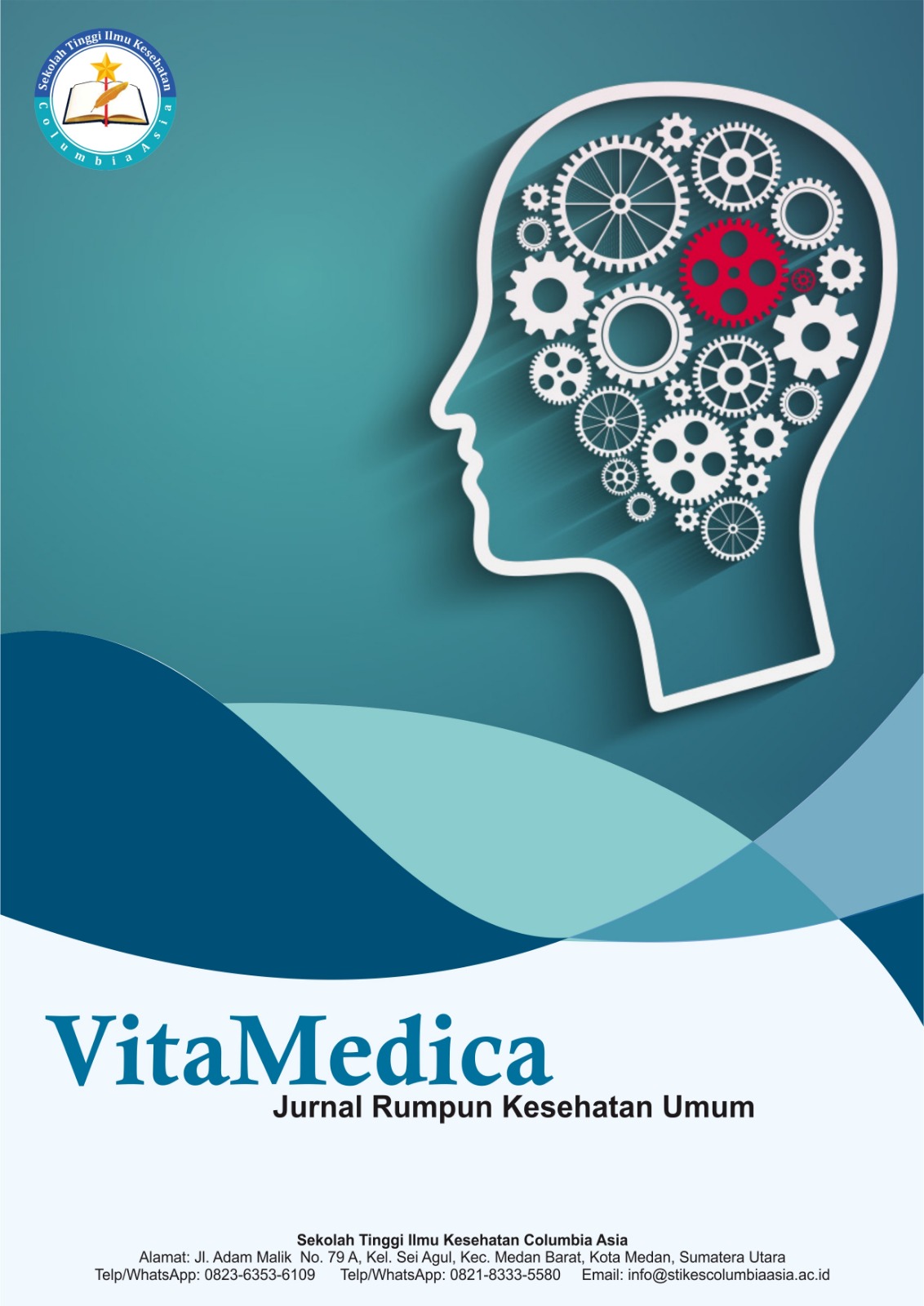
Determinan Pemberian ASI Eksklusif pada Baduta Sulung di Wilayah Kerja Puskesmas Dewantara, Kabupaten Aceh Utara
DOI:
https://doi.org/10.62027/vitamedica.v4i1.712Keywords:
Attitude, Breastfeeding Support, Exclusive Breastfeeding, First-born Toddlers, KnowledgeAbstract
Exclusive breastfeeding is the provision of only breast milk without any other food or drink from birth to six months of age. The practice of exclusive breastfeeding is very important in supporting infant growth and development and reducing infant morbidity and mortality. However, the coverage of exclusive breastfeeding is still not optimal, including for mothers with first-born children (first-born toddlers). This study aims to determine the determinants of exclusive breastfeeding in first-born toddlers in the work area of Dewantara Health Center, North Aceh with variables of knowledge, attitude, and support for breastfeeding. This study uses a quantitative research type with a cross-sectional design. The population in this study were all mothers who had their first-born children (first-born toddlers) in the work area of Dewantara Health Center, as many as 30 people. The sampling technique used total sampling so that the entire sample population was used. Data collection was carried out using a questionnaire and analyzed using the Chi-Square test. The results showed no significant relationship between maternal knowledge and exclusive breastfeeding (p=0.241), no relationship between maternal attitudes and exclusive breastfeeding (p=0.786), and no relationship between breastfeeding support and exclusive breastfeeding (p=0.850). The conclusion of this study is that knowledge, attitudes, and support for breastfeeding are not significantly related to exclusive breastfeeding in first-born toddlers. It is recommended that health workers improve breastfeeding education and support, and strengthen family support for the success of exclusive breastfeeding.
References
Amin F.A., Pendampingan Pemberian ASI Eksklusif pada Bayi Puskesmas Lut Tawar Kabupaten Aceh Tengah, BEMAS: Jurnal Bermasyarakat, 2026;6(2):223-229.
Asnidawati A. & Ramdhan S., Hambatan Pemberian ASI Eksklusif Pada Bayi Usia 0-6 Bulan, Jurnal Ilmiah Kesehatan Sandi Husada, 2021;10(1):156-162.
Chusniah Rachmawati W., Promosi kesehatan dan ilmu perilaku, 2019.
Dhirah U.H., Rosdiana E., Anwar C. & Marniati M., Hubungan perilaku ibu tentang 1000 hari pertama kehidupan dengan status gizi baduta di Gampong Mibo Kecamatan Banda Raya Banda Aceh, Journal of Healthcare Technology and Medicine, 2020;6(1):549-561.
Guterres D.M., HUBUNGAN DUKUNGAN KELUARGA (SUAMI) DENGAN PEMBERIAN ASI EKLUSIF DI WILAYAH PERKOTAAN DAN PEDESAAN: SCOPING REVIEW: The Relationship Between Family Support (Husband) and Exclusive Breastfeeding in Urban and Rural Areas: A Scoping Review, Jurnal Ilmiah Kebidanan (Scientific Journal of Midwifery), 2025;11(2):122-133.
Kholid A., Promosi Kesehatan: Dengan Pendekatan Teori Perilaku, Media, dan Aplikasinya untuk Mahasiswa dan Praktisi Kesehatan-Rajawali Pers: PT. RajaGrafindo Persada; 2023.
Khotimah K., Satillah S.A., Fitriani V., Miranti M., Maulida M., Hasmalena H., et al., Analisis manfaat pemberian ASI eksklusif bagi ibu menyusui dan perkembangan anak, PAUDIA, 2024:254-266.
Lestiarini S. & Sulistyorini Y., Perilaku ibu pada pemberian makanan pendamping ASI (MPASI) di Kelurahan Pegirian, Jurnal Promkes, 2020;8(1):1.
Manullang J.B., Aspek Sosial Budaya Dalam Pemberian Asi Eksklusif Ibu Bekerja Di Desa Selayang Kabupaten Langkat Tahun 2017, Journal of Midwifery Senior, 2020;3(1):72-81.
Mawaddah S., Keputusan Ibu dalam Memberikan ASI Eksklusif: Penerbit NEM; 2022.
Octamelia M. & Wahyudi D.T., Faktor Predisposing, Enabling, Dan Reinforcing Dalam Pemberian ASI Eksklusif, Indonesia Berdaya, 2024;5(2):775-784.
Oktalina O., Muniroh L. & Adiningsih S., Hubungan dukungan suami dan dukungan keluarga dengan pemberian asi eksklusif pada ibu anggota kelompok pendukung asi (KP-ASI), Media Gizi Indonesia, 2015;10(1):64-70.
Parapat F.M., Haslin S. & Siregar R.N., Hubungan pengetahuan ibu dengan pemberian ASI eksklusif, Jurnal Kesehatan Tambusai, 2022;3(2):16-25.
Puspita T.D., Lubis M.V.P., Lestari W. & Suraya R., Faktor Pengetahuan, Sikap, Dan Praktik Dalam Pemberian ASI Ekslusif Pada Anak, Jurnal Ilmu Psikologi dan Kesehatan| E-ISSN: 3063-1467, 2025;1(4):213-220.
Riskedas, Hasil riset kesehatan dasar tahun 2018, Kementrian Kesehatan RI, 2018;53(9):1689-99.
Riskedas. Laporan Hasil Riset Kesehatan Dasar (Riskesdas), Jakarta: Kemenkes RI; 2023.
Riyanti E., Kep M., Mat S.K., Dewi N.T., Kep M., Mat S.K., et al., Breastfeeding self-efficacy dan intervensi holistik untuk keberhasilan ASI eksklusif: Nuansa Fajar Cemerlang; 2024.
Roba S. & Amri A., IMPLEMENTASI KEBIJAKAN PROMOSI ASI EKSKLUSIF DALAM UPAYA PENCEGAHAN STUNTING DI WILAYAH KERJA PUSKESMAS MASAMBA KABUPATEN LUWU UTARA, Journal I La Galigo: Public Administration Journal, 2025;9(2):71-79.
Sudargo T. & Kusmayanti N.A., Pemberian ASI ekslusif sebagai makanan sempurna untuk bayi: UGM press; 2023.
Sunaringtyas W.S. & Setiawan L., Transisi Peran Sebagai Ibu Dengan Kemampuan Merawat Bayi Pada Primipara, Health Care: Jurnal Kesehatan, 2024;13(1):113-118.
Tabelak M., Grouse T., Oematan S. & Talahatu A.H., Faktor-Faktor yang Berhubungan dengan Rendahnya Cakupan Asi Eksklusif pada Ibu Bekerja di Wilayah Puskesmas Penfui, Quantum Wellness: Jurnal Ilmu Kesehatan, 2024;1(4):71-90.
Downloads
Published
How to Cite
Issue
Section
License
Copyright (c) 2026 VitaMedica : Jurnal Rumpun Kesehatan Umum

This work is licensed under a Creative Commons Attribution-ShareAlike 4.0 International License.